Plate tectonics is the scientific theory that explain how the earths rigid outer layer are divided into several block called plates.
Have you ever wondered why the Earth experiences powerful earthquakes, why volcanoes erupt, or how enormous mountain ranges such as the Himalayas were formed?
The answer lies in one of the most important concepts in Earth science: plate tectonics.
The Earth’s surface may appear stable, but it is constantly changing. Beneath our feet, enormous sections of solid rock are slowly moving, interacting, colliding, separating, and sliding past one another. These movements have shaped the continents, created ocean basins, formed mountain ranges, and triggered some of the most powerful natural disasters in Earth’s history.
The scientific theory that explains these processes is known as the theory of plate tectonics.
In this article, we will explore what plate tectonics is, how tectonic plates move, what drives their movement, the different types of plate boundaries, and how plate tectonics influences earthquakes, volcanoes, mountains, and the evolution of our planet.
1. What Is Plate Tectonics?
Plate tectonics is the scientific theory that explains how Earth’s outer rigid layer is divided into several large and small pieces of solid rock, called tectonic plates, which move slowly over the underlying, relatively weaker and more ductile mantle.
These plates consist of the Earth’s lithosphere, which includes the crust and the uppermost rigid part of the mantle.
The plates move relative to one another, generally at rates of a few centimetres per year. Although this movement is extremely slow on a human timescale, it produces enormous geological changes over millions of years.
For example:
- The collision of the Indian Plate and Eurasian Plate helped form the Himalayas.
- The separation of tectonic plates created the Atlantic Ocean.
- The movement of the Pacific Plate contributes to the intense volcanic and earthquake activity around the Pacific Ring of Fire.
- The movement of plates along faults can generate destructive earthquakes.
In simple words, plate tectonics explains how the Earth’s surface moves and how this movement shapes the planet. education.nationalgeographic.org+2
Map Of The World’s Tectonic Plates – Brilliant Maps
8
2. What Are Tectonic Plates?
Tectonic plates are large, rigid slabs of the Earth’s lithosphere that fit together like pieces of a giant jigsaw puzzle.
The Earth’s lithosphere is divided into numerous plates of different sizes. Some are enormous and cover extensive areas, while others are relatively small.
Tectonic plates contain both continental and oceanic crust, or, in some cases, are predominantly oceanic.
Major tectonic plates of the Earth
The following are some of the major tectonic plates:
| Tectonic plate | Geographic location |
|---|---|
| Pacific Plate | Most of the Pacific Ocean |
| North American Plate | North America and adjoining ocean floor |
| South American Plate | South America and adjoining ocean floor |
| African Plate | Africa and surrounding ocean floor |
| Eurasian Plate | Europe and much of Asia |
| Antarctic Plate | Antarctica and surrounding ocean floor |
| Indo-Australian region | Indian Ocean, India and Australia; often represented by separate Indian and Australian plates |
Other important smaller plates include the Nazca Plate, Cocos Plate, Caribbean Plate, Arabian Plate, Philippine Sea Plate, and Scotia Plate.
Interesting fact: The Pacific Plate is the largest tectonic plate on Earth. Its movement and interaction with surrounding plates are responsible for much of the volcanic and earthquake activity around the Pacific Ocean.
3. What Causes Tectonic Plates to Move?
One of the most interesting questions in geology is: If tectonic plates are made of solid rock, how can they move?
The answer is related to heat inside the Earth and the forces acting on the lithosphere.
The Earth’s interior contains enormous amounts of thermal energy, originating from its formation and the radioactive decay of elements within the planet. This heat contributes to the slow movement of mantle material and helps drive plate tectonics.
Three important processes are involved in plate movement.
A. Mantle convection
Mantle convection is the slow movement of material within the Earth’s mantle due to differences in temperature and density.
Hotter mantle material tends to rise, while cooler, denser material tends to sink. This produces slow circulation within the mantle.
These movements contribute to the forces that move tectonic plates.
It is important to understand that the mantle is predominantly solid. It can deform and flow very slowly over geological timescales rather than behaving like an ocean of liquid magma.
B. Slab pull
Slab pull is considered one of the major forces driving plate movement.
When an old, cold oceanic plate becomes dense enough, it sinks into the mantle at a subduction zone. As the descending slab sinks, it pulls the remaining part of the plate behind it.
Think of a heavy blanket being pulled downward from one edge. The movement of the descending portion helps pull the rest of the blanket.
C. Ridge push
Ridge push occurs at mid-ocean ridges, where newly formed oceanic lithosphere is elevated relative to older seafloor.
Gravity causes the lithosphere to move away from the elevated ridge region, contributing to plate movement.
Together, mantle dynamics, slab pull, and ridge-related gravitational forces help explain why tectonic plates move. USGS Publications+2
Notes for D.1.1 Plate Tectonics and Mechanisms of Plate Movement – IB
4. What Are the Three Types of Plate Boundaries?
A plate boundary is the region where two or more tectonic plates meet and interact.
Based on their relative movements, there are three major types of plate boundaries:
- Divergent plate boundaries
- Convergent plate boundaries
- Transform plate boundaries
Each type produces different geological structures and natural processes.
A. Divergent Plate Boundary
9.4 Plates, Plate Motions, and Plate-Boundary Processes – Physical Geology
A divergent plate boundary develops when two tectonic plates move away from each other.
As the plates separate, hot mantle material rises to fill the gap. The material cools and solidifies, forming new oceanic crust.
This process is called seafloor spreading.
Major geological features:
- Mid-ocean ridges
- Rift valleys
- New oceanic crust
- Volcanic activity
- Shallow earthquakes
Examples:
- Mid-Atlantic Ridge
- East African Rift System
- Red Sea Rift
The Mid-Atlantic Ridge is a famous example where the North American and Eurasian plates move apart in the northern Atlantic, while the South American and African plates separate farther south.
B. Convergent Plate Boundary
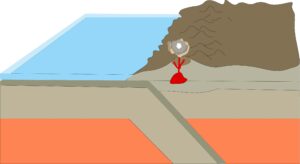
ملف:Oceanic-continental convergence Fig21oceancont.svg – المعرفة
A convergent plate boundary occurs when two tectonic plates move towards each other.
Depending on the types of plates involved, three major situations can develop.
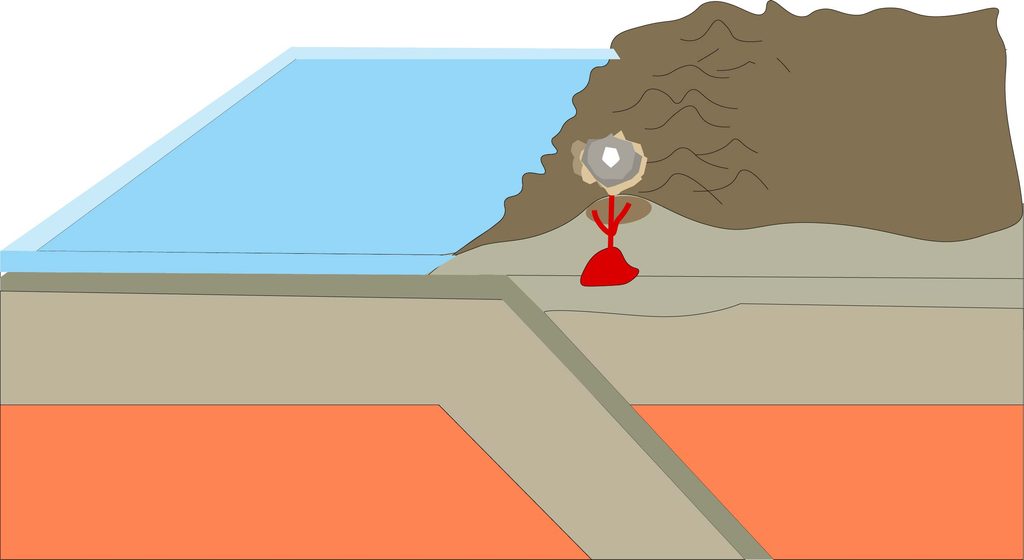
1. Oceanic–Continental Convergence
When an oceanic plate collides with a continental plate, the denser oceanic plate generally sinks beneath the continental plate.
This process is called subduction.
As the oceanic plate descends, it releases fluids that contribute to melting in the mantle above it. Magma can rise and form volcanoes.
Example: The Nazca Plate moving beneath the South American Plate, contributing to the formation of the Andes Mountains.
2. Oceanic–Oceanic Convergence
When two oceanic plates collide, the older and generally denser plate usually sinks beneath the other.
This process can create deep ocean trenches and volcanic island arcs.
Example: The Mariana Trench and the Mariana Islands.
3. Continental–Continental Convergence
When two continental plates collide, neither plate easily sinks deep into the mantle because continental crust is relatively buoyant.
Instead, the crust becomes compressed, folded, thickened, and uplifted.
This process produces enormous mountain ranges.
Example: The Indian Plate colliding with the Eurasian Plate, resulting in the formation and continued uplift of the Himalayas.
C. Transform Plate Boundary
Type Of Plate Boundary In San Andreas Fault at Mike Kaufman blog
dxopdvrxr.blob.core.windows.net
A transform plate boundary occurs when two tectonic plates slide horizontally past one another.
Unlike divergent boundaries, new crust is not created. Unlike convergent boundaries, crust is not generally destroyed through subduction.
Friction may cause the plates to become temporarily locked. When accumulated stress is suddenly released, earthquakes occur.
Major geological features:
- Strike-slip faults
- Shallow earthquakes
- Linear valleys
- Offset rivers and geological structures
Example: The San Andreas Fault in California, United States, is one of the best-known examples of a transform plate boundary.USGS Publications+2
Comparison of the three major plate boundaries
| Feature | Divergent | Convergent | Transform |
|---|---|---|---|
| Plate movement | Away from each other | Towards each other | Slide past each other |
| Crust formation | New crust forms | Crust may be recycled or thickened | No significant creation or destruction |
| Main processes | Seafloor spreading | Collision and subduction | Strike-slip movement |
| Common landforms | Ridges and rift valleys | Mountains and trenches | Fault zones |
| Earthquakes | Usually shallow | Shallow to deep | Mostly shallow |
| Volcanic activity | Common in many settings | Common at subduction zones | Generally uncommon |
5. What Is the Difference Between Continental Drift and Plate Tectonics?
Continental drift and plate tectonics are closely related concepts, but they are not exactly the same.
Continental drift is the idea that continents have moved over geological time. Plate tectonics is the broader scientific theory that explains how the Earth’s lithospheric plates move and interact, carrying both continents and ocean floors.
In 1912, German scientist Alfred Wegener proposed the theory of continental drift.
He suggested that the continents were once joined together in a single supercontinent called Pangaea.
Over millions of years, Pangaea gradually broke apart, and its fragments moved towards their present-day positions.
However, Wegener could not provide a convincing mechanism to explain how continents moved.
Later discoveries of seafloor spreading, magnetic reversals, and the distribution of earthquakes and volcanoes helped scientists develop the modern theory of plate tectonics during the 1960s. USGS Publications+2
ektalks: Plate Tectonics; Continental Drift; Radio-isotope Dating of Oceanic Crust
Evidence supporting plate tectonics
Several important geological observations support the theory of plate tectonics.
1. The jigsaw fit of continents
The coastlines of South America and Africa appear to fit together remarkably well. This observation was one of the early clues suggesting that continents were once connected.
2. Matching fossils
Similar fossil species have been discovered on continents now separated by oceans. For example, fossils of the ancient freshwater reptile Mesosaurus have been found in both South America and Africa.
3. Similar rock formations and mountain belts
Geologists have identified comparable rock sequences and geological structures on continents separated by large distances.
4. Paleomagnetism and magnetic stripes
As basaltic lava cools at mid-ocean ridges, magnetic minerals preserve the direction of Earth’s magnetic field at that time.
Because Earth’s magnetic field has reversed repeatedly throughout geological history, alternating magnetic stripes occur on either side of many mid-ocean ridges. These patterns provide strong evidence for seafloor spreading.
5. Seafloor age
Oceanic crust is generally youngest near mid-ocean ridges and becomes progressively older away from them. This pattern supports the continuous formation and movement of oceanic crust.
6. Earthquake and volcano distribution
Earthquakes and volcanoes are not randomly distributed across the Earth. Many occur along tectonic plate boundaries, providing evidence of active plate interactions.USGS Publications+2
6. How Does Plate Tectonics Cause Earthquakes?
Earthquakes are among the most significant geological consequences of plate movement.
When tectonic plates move, they interact along faults and plate boundaries. Friction may prevent rocks from moving freely, causing stress to accumulate.
When the stress exceeds the strength of the rocks or the friction holding the fault, sudden movement occurs. The stored elastic energy is released as seismic waves, producing an earthquake.
Different types of plate boundaries generate different patterns of earthquake activity.
- Convergent boundaries: Can generate powerful earthquakes, including shallow, intermediate-depth, and deep earthquakes in subduction zones.
- Divergent boundaries: Commonly produce shallow earthquakes as plates separate.
- Transform boundaries: Generate shallow earthquakes when plates slide past one another.
For example, the 2011 Tohoku earthquake in Japan occurred along a subduction zone where the Pacific Plate moves beneath the plate carrying northeastern Japan.
Shallow Earthquake – KSG India
Understanding plate tectonics is therefore essential for earthquake science, seismic hazard assessment, and disaster risk reduction. USGS Publications+1
7. How Does Plate Tectonics Form Mountains?
Mountain formation is one of the most spectacular results of tectonic plate interactions.
When two continental plates collide, the rocks and sediments between them become compressed. The crust may fold, fracture, thicken, and rise, producing enormous mountain ranges.
This process is called orogeny, or mountain building.
Examples of mountains formed by plate tectonics
1. Himalayas
Formed mainly through the collision of the Indian and Eurasian plates. The collision and crustal shortening continue today.
Volcan Llullaillaco | Hike Chile
2. Andes Mountains
Formed largely through the subduction of the Nazca Plate beneath the South American Plate.
Aerial view of mountains and valleys
3. Alps
Developed through the complex convergence and collision of African-related and Eurasian continental regions.
Plate tectonics also produces volcanic mountains, island arcs, and underwater mountain systems.
8. How Does Plate Tectonics Cause Volcanic Activity?
Volcanic activity is strongly associated with tectonic plate movement, particularly at divergent and convergent plate boundaries.
At divergent boundaries, plates move apart, allowing mantle material to rise and partially melt as pressure decreases. This produces magma that can form new oceanic crust.
At convergent boundaries, an oceanic plate descends beneath another plate. Water and other volatile components released from the subducting plate promote melting in the mantle above it, generating magma.
The magma may rise towards the Earth’s surface and erupt through volcanic openings.
The Pacific Ring of Fire is one of the world’s most important volcanic and seismic regions.
Examples of tectonically related volcanoes:
- Mount Fuji, Japan
- Mount St. Helens, United States
- Mount Etna, Italy
- Popocatépetl, Mexico
- Mount Merapi, Indonesia
It is worth noting that not all volcanoes occur at plate boundaries. Some, such as those in Hawaii, are associated with mantle hotspots. education.nationalgeographic.org+1
9. Why Is Plate Tectonics Important in Earth Science?
Plate tectonics is considered the unifying theory of modern geology because it connects many different geological processes into a single scientific framework.
It helps scientists understand:
- Earthquake distribution: Why earthquakes occur in particular regions.
- Volcanic activity: Why volcanoes are concentrated in certain parts of the world.
- Mountain building: How major mountain ranges develop.
- Ocean basin formation: How oceans open, expand, and eventually close.
- Continental evolution: How continents change their positions over millions of years.
- Mineral resources: How tectonic processes contribute to the formation and concentration of economically important mineral deposits.
- Sedimentary basin development: How tectonic subsidence and uplift influence sediment accumulation.
- Earth’s geological history: How continents, oceans, and geological environments have evolved through time.
Plate tectonics is also important for understanding natural hazards, geological mapping, resource exploration, and environmental management.
10. Plate Tectonics and Bangladesh: Why Is It Important?
Plate tectonics is particularly important for understanding the geological structure and earthquake hazards of Bangladesh.
Bangladesh is situated in the Bengal Basin, a geologically complex region influenced by the interactions of the Indian, Eurasian, and Burma plates.
The collision of the Indian Plate with the Eurasian Plate contributed to the formation and uplift of the Himalayas. To the east, the interaction between the Indian Plate and the Burma Plate has contributed to the development of the Indo-Burman fold-and-thrust belt.
Several important tectonic structures influence the geology of Bangladesh and its surrounding region.
- Himalayan tectonic system: Associated with the convergence of the Indian and Eurasian plates.
- Dauki Fault: A major tectonic structure along the southern margin of the Shillong Plateau.
- Indo-Burman Fold Belt: A tectonically active fold-and-thrust system east of Bangladesh.
- Rakhine-Bangladesh Megathrust: A major plate-boundary structure associated with the convergence of the Indian and Burma plates.
3 plates, 6 faults behind quakes: 24 districts including Dhaka at high risk | The Daily Campus
These tectonic processes are important for understanding earthquake hazards in Bangladesh, particularly in the northeastern and southeastern regions.
The interaction of these plates has also influenced the formation of the Bengal Basin, its sedimentary architecture, and the development of the Ganges-Brahmaputra-Meghna delta system.
For this reason, understanding plate tectonics is essential for earthquake hazard assessment, geological research, urban planning, and disaster resilience in Bangladesh. Taylor & Francis Online+3
11. How Fast Do Tectonic Plates Move?
Tectonic plates move very slowly compared with everyday human activities.
Most plates move at rates of a few centimetres per year, although their speeds vary considerably.
For comparison:
- Some plates move less than 1 cm per year.
- Many plates move approximately 2–5 cm per year.
- Some plates move more than 10 cm per year.
This movement is approximately comparable to the rate at which human fingernails grow.
Although the movement seems insignificant, over millions of years it can shift continents thousands of kilometres, open new oceans, and create enormous mountain systems.education.nationalgeographic.org+1
12. Frequently Asked Questions (FAQs) About Plate Tectonics
1. What is plate tectonics in simple words?
Plate tectonics is the scientific theory that explains how the Earth’s outer rigid layer is divided into large and small pieces called tectonic plates. These plates move slowly and interact with one another, causing earthquakes, volcanic eruptions, and mountain formation.
2. How many tectonic plates are there on Earth?
Earth has seven commonly recognized major plates, although the exact number depends on how smaller plates and microplates are classified. Scientists recognize numerous smaller plates as well.
3. What are the three main types of plate boundaries?
The three main types are divergent, convergent, and transform plate boundaries. They are classified according to how tectonic plates move relative to each other.
4. What is the main cause of plate movement?
Plate movement is driven by forces associated with Earth’s internal heat and mantle dynamics. Slab pull, ridge push, and mantle flow are important contributors.
5. Who proposed the theory of continental drift?
Alfred Wegener proposed the theory of continental drift in 1912. His work helped establish the foundation for the modern theory of plate tectonics.
6. What is the difference between continental drift and plate tectonics?
Continental drift explains the movement of continents over geological time, whereas plate tectonics explains the movement and interaction of the entire lithosphere, including both continental and oceanic plates.
7. Which is the largest tectonic plate?
The Pacific Plate is the largest tectonic plate on Earth.
8. Can tectonic plates stop moving?
Plate movement is part of Earth’s ongoing geological evolution. The movement and configuration of plates can change over geological time, but there is no indication that global plate tectonics is about to stop.
9. Why does Bangladesh experience earthquakes?
Bangladesh is influenced by the interaction of the Indian, Eurasian, and Burma plates, together with several active faults and tectonic structures. These geological processes contribute to the region’s earthquake hazard.
10. Is the Earth’s mantle liquid?
No. Most of the mantle is solid rock. However, it can deform and flow very slowly over geological timescales because of the high temperatures and pressures inside the Earth.
Conclusion: Plate Tectonics Explains Our Dynamic Earth
Plate tectonics is one of the most important scientific theories for understanding how our planet works.
It explains why continents move, how oceans develop, why mountains rise, and why earthquakes and volcanic eruptions occur in particular regions.
From the formation of the Himalayas to the opening of the Atlantic Ocean, plate tectonic processes have continuously transformed the Earth’s surface over millions of years.
Understanding plate tectonics is not only important for geologists but also for geographers, environmental scientists, engineers, disaster management professionals, and anyone interested in the evolution of our planet.
The ground beneath our feet may seem permanent, but the Earth is a dynamic planet that is continuously changing.